How to Follow Up on a Quote Without Chasing (Templates)
 Cameron Richards, FounderUpdated 7 min read
To follow up on a quote without chasing, send five short messages on day 1, day 3, day 7, day 14 and day 30, then move to monthly. Each one restates the exact job and price and asks one easy question. That cadence matters because 63% of people who request information don't buy for three months or more.
You measured up, priced the job, sent a professional quote. Then nothing. A week later you send "just checking you received my quote?" and the silence continues. Most installers send one awkward follow-up and give up inside a fortnight. The homeowner is still deciding. You've just stopped being part of the decision.
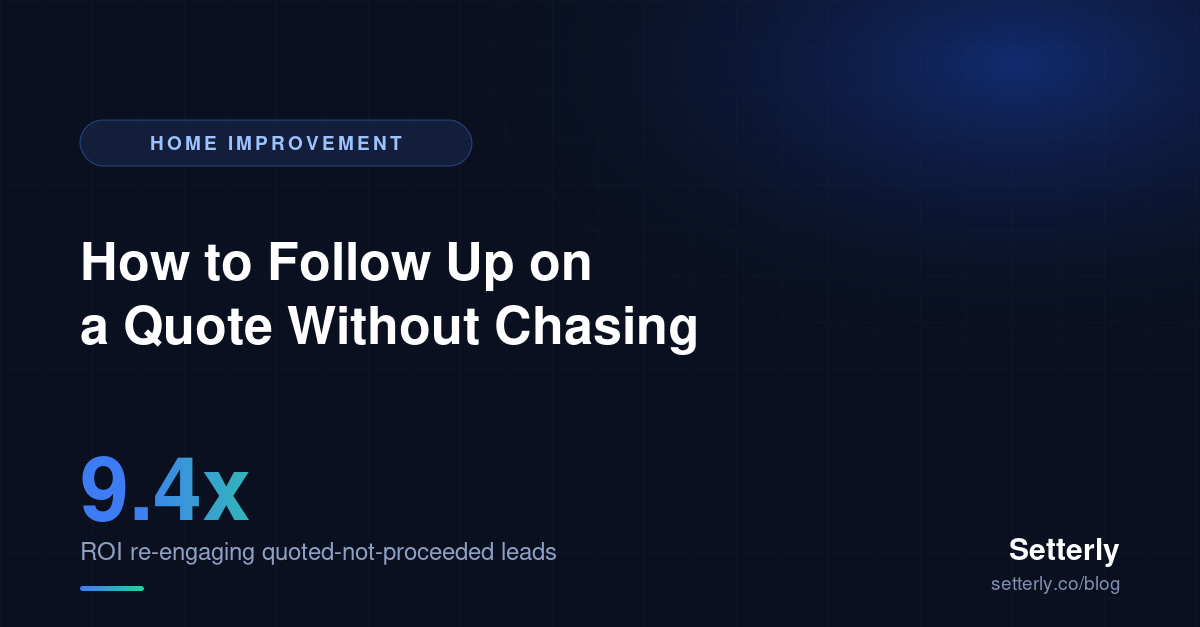
This guide covers why customers go quiet after a quote, the follow-up timings that work, exactly what to say, and the "quoted, not proceeded" play we ran for a UK glazing franchise.
Why the customer isn't responding to your quote
A homeowner planning a new bathroom, windows or driveway almost always collects two or three quotes. The moment you send yours, you enter a comparison you can't see.
Then normal life takes over. They're waiting for the other quotes to arrive. They need to talk it through with a partner. The money lands next month. The kids are off school. None of these mean no.
Silence after a quote usually means "still deciding". Most installers hear it as rejection, feel awkward about chasing, and quietly file the lead away. Research shows contractors lose 30-50% of their leads to poor follow-up, and quoted leads are the most expensive ones to lose because you've already invested the survey, the pricing and the paperwork.
Why "just checking in" kills the sale
"Just checking in" and "did you get my quote?" fail for the same reason. They put all the work on the customer.
To reply, the homeowner has to dig out your quote, remember the figure, remember what it covered, and form an opinion. That's effort. Effort gets postponed, and postponed becomes forgotten.
A good quote follow-up does the remembering for them. It restates the job, restates the price, and asks one easy question. When the message carries the context, replying takes ten seconds.
There's a second problem with the generic check-in. It signals you have nothing new to say, which reads as chasing. Every message in your follow-up sequence should either add information, remove a barrier, or make a decision easier.
The quote follow-up structure that works
Here's a full sequence you can run for any home improvement quote. Adjust the wording to your trade, keep the timings.
Day 1: confirm and set expectations
Within 24 hours of sending the quote, send a short message confirming they've got everything and telling them what happens next. This is where you earn permission for the rest of the sequence.
"Hi Sarah, quote for the six windows and front door came through yesterday, £4,850 all in. Any questions on the spec, just reply here. I'll check back in a few days once you've had a chance to look at it properly."
You've referenced the exact scope and the exact figure, answered the "did it arrive" question before it exists, and told them you'll be in touch. Now your next message is expected instead of a chase.
Day 3: answer the question they haven't asked
Most quoted leads stall on one hidden question: price, timing, disruption, or trust. Pick the most common one for your trade and answer it unprompted.
"Morning Sarah. One thing people usually ask at this stage: the £4,850 covers fitting, waste removal and the 10 year guarantee, so there's nothing extra on top. Happy to break any of it down."
Day 7: ask the direct question
A week in, be straight. Reference the quote value again and ask where things stand.
"Hi Sarah, wanted to see where you'd got to on the windows. The £4,850 quote is valid until the end of the month. Are you leaning towards going ahead, or still comparing?"
"Still comparing" is a brilliant answer to receive. It's honest, it keeps the conversation alive, and it invites you to ask what would make the decision easier.
Day 14: make starting easy
If they're quiet at two weeks, reduce the size of the next step.
"Hi Sarah, no pressure either way on the quote. If it's a timing thing, we're booking installs about three weeks out at the moment, so there's no rush to decide today. Want me to pencil a date you could still cancel?"
Day 30 and beyond: the long game
After a month, drop to a monthly rhythm. Seasonal angles work well here: energy bills for glazing, summer for driveways, pre-Christmas for kitchens. Remember, most of these buyers are still inside that three month decision window. If you want the full system for leads older than this, our database reactivation guide covers it step by step, and how many times to follow up with a lead maps the longer cadence.
Running this sequence manually across every open quote is where most firms fall down. It's the exact problem we built Setterly to solve, and you can see the mechanics on our how it works page. You only ever pay for booked, qualified appointments, so if it books nothing, it costs nothing.
The "quoted, not proceeded" play
Here's the highest value segment in any installer's CRM: people who received a quote and never said yes or no. They passed your qualification, they saw your price, and then the file went quiet.
Cloudy2Clear, a UK misted double glazing repair franchise, had thousands of these sitting across their branches. We re-engaged 6,769 old enquiries by SMS, and for the quoted segment the AI did something very specific: it reminded each prospect of their exact quote figure and asked if they were happy to proceed. A message in that style reads like this:
"Hi John, it's Cloudy2Clear. We quoted £340 to replace the two misted units in your lounge back in April. Are you happy to go ahead, or has anything changed?"
That precision changes who replies. Someone who answers a message quoting their exact price and exact job has effectively re-accepted the quote before anyone picks up the phone. Across the whole campaign, 4,321 people replied (a 64% reply rate), 673 booked appointments and the pipeline reached £639,350, with £107,000+ closed. The full breakdown is in our Cloudy2Clear case study.
Every quoted booking arrives pre-sold on a known price. For a sales team, those are the easiest jobs of the month. Glazing firms can see how this works for their trade on our windows and doors page.
Copy-and-paste quote follow-up templates
Swap in your trade, figures and names. Keep the structure: exact scope, exact price, one easy question.
- The day-after confirmation: "Hi [name], quote for [job] went over yesterday, [£X] including [key inclusion]. Any questions, just reply here. I'll check back later this week."
- The comparison-friendly nudge: "Hi [name], guessing you're comparing a couple of quotes for [job], which is the right way to do it. If anything in ours needs explaining or matching, tell me and I'll look at it."
- The direct ask: "Hi [name], where did you land on the [job]? The [£X] quote holds until [date]. Leaning towards going ahead, or still weighing it up?"
- The reactivation message: "Hi [name], it's [Your company]. We quoted [£X] for [job] back in [month]. Are you happy to proceed, or has anything changed?"
- The graceful close: "Hi [name], last one from me on the [job]. If the timing's wrong I'll leave it with you, and the quote's here whenever you're ready. If you'd like it refreshed at any point, just reply."
Stop writing quotes off
Every unanswered quote in your CRM is a job you already priced for a customer who already asked. The follow-up structure above wins a good share of them back, and automation runs it across every open quote at once without you chasing anyone.
Setterly has booked 3,000+ appointments through 260,000+ real SMS conversations doing exactly this. See the numbers on our results page.
Frequently asked questions
How long should you wait before following up on a quote?
Follow up within 24 hours of sending the quote to confirm it arrived and invite questions. Then follow up again on day 3, day 7, day 14 and day 30, moving to monthly contact after the first month. Most buyers take weeks to decide, so a single follow-up leaves money on the table.
How many times should you follow up on a quote?
Plan for at least five touches over 30 days, then monthly after that. Since 63% of buyers take three months or longer to decide, stopping after one or two messages means you disappear long before the decision gets made. Vary the message each time so every touch adds something new.
What do you say when a customer doesn't respond to a quote?
Reference the exact job and the exact price, then ask one easy question. For example: "We quoted £4,850 for the six windows in March. Are you happy to go ahead, or has anything changed?" Messages that carry the full context get replies because the customer can answer in seconds without digging out paperwork.
Should you follow up on quotes by phone or text?
Text first, phone second. SMS open rates run at around 98% against roughly 20% for email, and calls from a busy installer's mobile often go unanswered. Use SMS to restart the conversation and confirm interest, then call once the customer has replied and is expecting you.