Car Sales Follow-Up: Timing, Channels and Messages That Get Replies
 Cameron Richards, FounderUpdated 7 min read
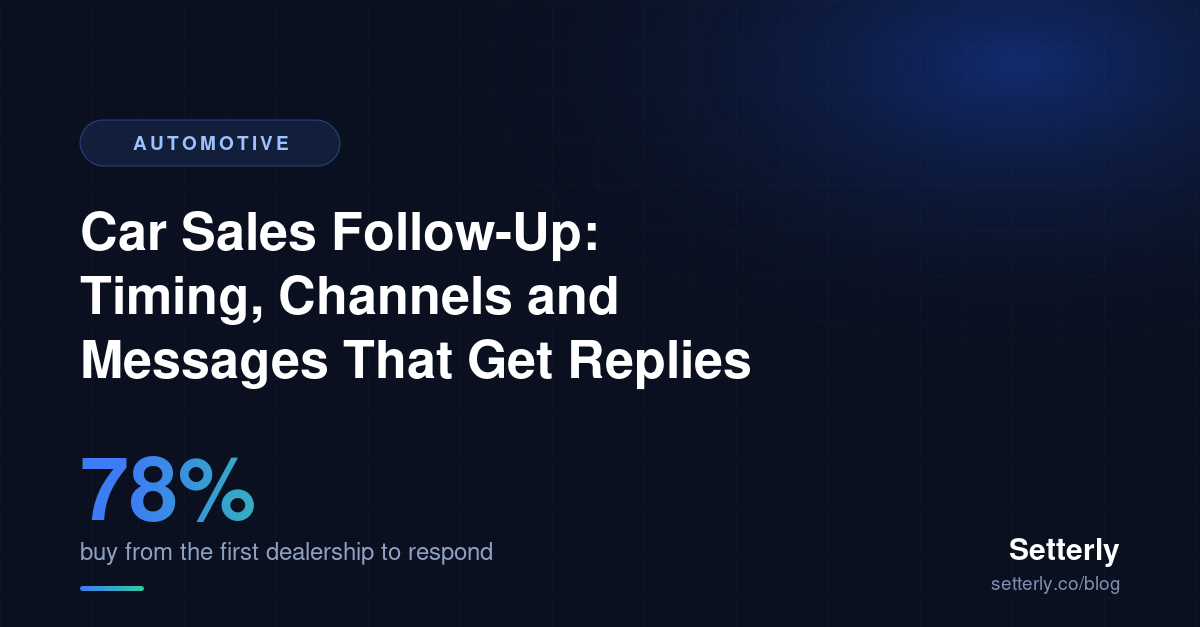
Effective car sales follow-up starts with a reply inside 5 minutes, leads with SMS, and keeps going with six specific touches across the first week before moving to monthly re-engagement. Speed decides most deals: 78% of car buyers purchase from the first dealership that responds, yet the average dealership takes 47 minutes.
Read those two numbers together and the conclusion writes itself. Most dealerships lose the sale in the gap between the enquiry landing and anyone picking it up.
This is the follow-up playbook that closes that gap. Timing first, then channel order, then the actual messages, then what to do with leads that have already gone quiet.
Car sales follow-up timing: the first hour decides most deals
The 5-minute window is the whole game on fresh leads. A shopper who enquires about a used Tiguan on your site has usually enquired about two others elsewhere in the same sitting. Whoever answers first gets the conversation, and 78% of the time gets the sale.
So the standard for a new enquiry is a reply within 5 minutes, every time, including evenings and weekends. That last part matters more than most managers realise: 56% to 60% of dealership leads arrive after hours, when nobody is at a desk to answer them.
If your first response currently averages anywhere near the industry's 47 minutes, fixing that single number will move more metal than any script change on this page. We covered the evidence in depth in our speed to lead statistics post.
The first-week cadence
One reply is a start. A sale usually takes several touches, because car buyers browse at 9pm, get busy, and come back to the decision days later.
Here is a first-week cadence that works without feeling like harassment:
- Minute 0-5: SMS acknowledging the exact vehicle and asking one easy question.
- Hour 1: phone call attempt. If no answer, no voicemail yet, just a follow-up text.
- Day 1: second SMS with something new: availability, a similar car, a finance figure.
- Day 2: second call attempt, voicemail this time, short and specific.
- Day 4: SMS with a soft deadline or update ("had two viewings booked on this one this week").
- Day 7: email recapping the vehicle, photos, and a direct booking link.
Six touches across seven days, three channels, every message carrying something specific. Most dealerships stop after one or two attempts, which is one of the five leaks we walked through in car dealer lead follow-up.
Channel order: SMS first, phone second, email last
The order matters as much as the cadence.
SMS goes first because it gets read. It reaches the web-form lead who gave no phone preference, it lands silently during a work meeting, and it gets answered from the sofa at 9pm. It is also low pressure, which is exactly what a browsing car buyer wants from a first touch.
Phone goes second, after the SMS has warmed the ground. A call from a number that just texted you politely converts far better than a cold ring from an unknown dealership. Calls are where you handle trade-in questions, finance detail, and the actual booking if the lead prefers to talk.
Email goes last. It is the archive channel: photos, spec sheets, finance illustrations, a booking link the buyer can forward to a partner. Almost nobody replies to a dealership email quickly, so it should never be your opening move.
Car dealership follow-up scripts that actually get replies
Every message below follows the same three rules. Name the exact vehicle. Ask one question. Keep it under 40 words.
Generic follow-up dies on arrival. "Just checking in on your recent enquiry" tells the buyer you have no idea who they are. "The grey 2021 Golf R you asked about" tells them a human is holding their car.
First-touch SMS (minute 0-5)
"Hi Sarah, thanks for asking about the grey 2021 Golf R at [Dealership]. It's still available. Were you looking to come and see it this week, or shall I send over a video walkaround first?"
Day 1 SMS (add something new)
"Morning Sarah, quick update on the Golf R. We can do it at £389/month with your £2k deposit. Happy to hold it until Saturday if you want to view. Would Saturday morning work?"
Day 2 voicemail (short and specific)
"Hi Sarah, it's James at [Dealership] about the grey Golf R. I've texted you the finance figure. If it helps I can get it valeted and ready for a test drive this weekend. Text me back whenever suits."
Day 4 SMS (honest urgency)
"Hi Sarah, being straight with you, we've had two other enquiries on the Golf R this week. If you're still interested I'd rather you saw it first. Any evening this week work for a quick look?"
Day 7 email (the archive touch)
Subject: "Your Golf R: photos, finance and a booking link"
Body: recap the car, attach photos, restate the monthly figure, one-click booking link. Close with "reply to this or text me on [number], whichever is easier."
Steal these, swap in your stock, and your reply rate moves. The vehicle-specific detail is the part most dealerships skip and the part that does the work.
How to revive leads aged 30 to 90+ days
Now the part almost every dealership ignores. The leads from last month and last quarter that went quiet are still buyers. Car purchase cycles run for weeks and months, and a lead who ghosted you in March is frequently still in the market in May, driving the same tired car that made them enquire in the first place.
The message that reopens these conversations is different from a fresh follow-up. Pressure fails here. Curiosity and ease win.
30-60 days: "Hi Mark, it's [Dealership]. You asked about a Kuga back in April and we lost touch. Are you still looking, or did you sort a car in the end?" That last question is the trick. It is effortless to answer either way, and the "still looking" replies come flooding out.
60-90+ days: lead with something changed. "Hi Mark, [Dealership] here. Since you last looked, we've had a few 2022 Kugas arrive around the £280/month mark. Worth a fresh look, or are you all sorted?"
Run this across a full CRM export and the response volume surprises everyone the first time. These people already told you they wanted a car. Most were simply never asked again. We wrote a full guide on this in what to do with old leads in your CRM, and the wider method is in our database reactivation guide.
Where AI takes over the volume humans can't cover
Here is the honest maths of everything above. Six touches per lead, across three channels, within tight time windows, on hundreds of leads a month, more than half of which arrive after hours. No BDC team covers that manually. The playbook is sound and the staffing makes it impossible.
This is the exact gap Setterly fills. Our AI opens real two-way SMS conversations with every lead, new and aged, within minutes of the enquiry or the reactivation send. It references the exact vehicle, answers questions, handles "what's the best price" and "is it still available", qualifies the buyer, and books the appointment straight into your diary. Your salespeople walk in to a calendar of booked test drives. The full process is on our how it works page.
The proof sits in our dealer campaigns. A five-site UK used car dealer reactivated 827 old leads, 65% replied and 61 appointments were booked, £109,800 in pipeline. A franchised dealer group with 20+ sites booked 91 appointments from 725 old leads.
CarFinance247, a UK car finance broker, shows the same effect on finance enquiries. Over Christmas, Setterly ran AI SMS conversations on 3,895 leads its 200-strong sales team had already worked for two weeks, and booked 114 appointments and £171,000 in pipeline. Emily Henshall, Head of Paid Media at CarFinance247, put it like this: "Setterly helped us unlock additional value from a database of over 1,000,000 leads through AI-driven SMS outreach."
Across all clients, Setterly has booked 3,000+ appointments through 260,000+ SMS conversations. More numbers are on our results page, and dealers can see how it fits their operation on our car dealerships page.
Frequently asked questions
How quickly should a dealership follow up on a lead?
Within 5 minutes. 78% of car buyers purchase from the first dealership that responds, and the average dealership takes 47 minutes. Responding inside 5 minutes, including evenings and weekends, is the single biggest advantage available in automotive follow-up.
How many times should you follow up with a car lead?
Six to eight touches across the first two weeks, then monthly re-engagement after that. Most dealerships stop after one or two attempts, which is where the majority of paid leads are lost. Persistence with a specific reason for each message outperforms volume alone.
What is the best channel for automotive follow-up?
SMS first, phone second, email last. SMS gets read within minutes, works after hours, and reaches web-form leads a call cannot. Calls convert warm conversations into bookings. Email carries photos, finance detail and booking links.
Are car leads older than 30 days worth following up?
Yes. Car buying cycles run for weeks or months, so a 30-90 day old lead is frequently still in the market. A five-site UK used car dealer booked 61 appointments from 827 old leads, and CarFinance247 booked 114 from leads its sales team had already worked.