How to Re-Engage Old Leads by SMS (Without Annoying Them)
 Cameron Richards, FounderUpdated 7 min read
To re-engage old leads by SMS, send a short text that references their original enquiry, asks one easy question and offers a clear opt-out, then hold a real conversation with whoever replies. Most businesses call twice, email once and give up, and contractors lose 30-50% of their leads this way.
Here is the uncomfortable part. A large share of those "dead" leads still want the work done. 63% of people who request information don't buy for three months or more. They went quiet because life got in the way, and nobody followed up when the timing was right.
SMS is the best channel for waking them up. This post covers why, what a good re-engagement text looks like, a real conversation from our own campaigns, and the mistakes that get numbers blocked and brands reported.
Why SMS wins for lead re-engagement
Three reasons, all practical.
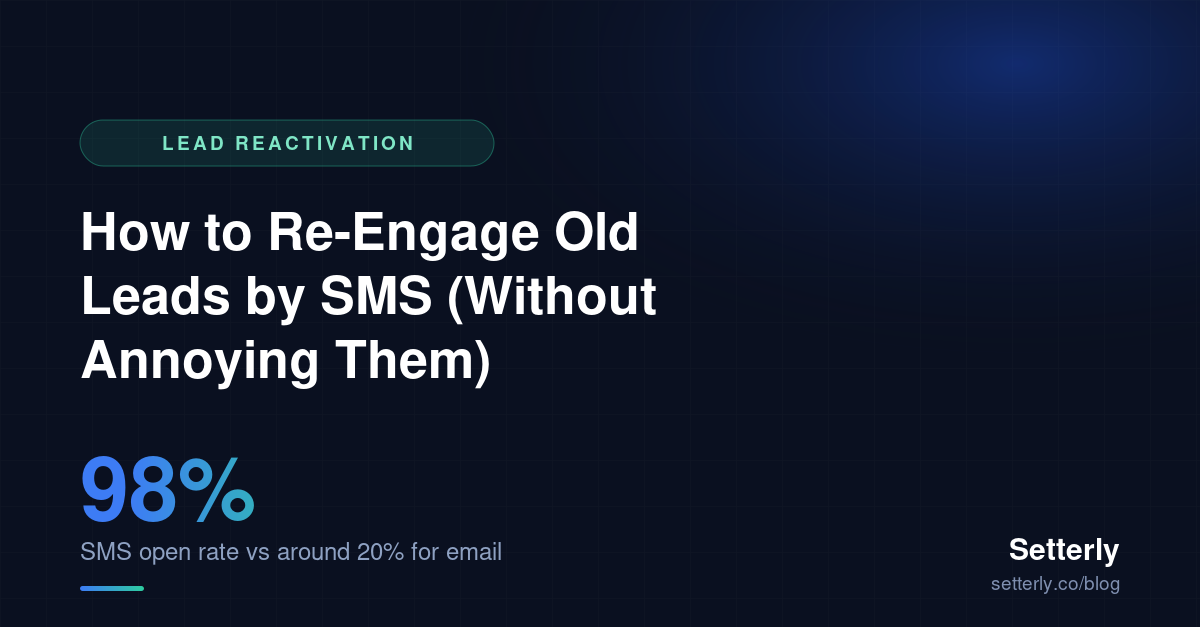
It gets seen. SMS open rates sit around 98%, compared with roughly 20% for email. An email to a six-month-old lead lands in a crowded inbox next to forty other pitches. A text lands on the lock screen and gets read within minutes.
It is conversational. A text invites a reply. Nobody replies to a marketing email, but people answer texts all day. Re-engagement works when the lead talks back, because their reply tells you whether the enquiry is still live.
It is low friction for the lead. Answering a call from an unknown number feels like a commitment. Replying "yes, still interested" from the sofa takes four seconds. You want the lowest possible barrier between a lukewarm lead and a signal of intent. We go deeper on this in why your leads don't answer the phone.
We have handled 260,000+ SMS conversations at Setterly, and the pattern is consistent across home improvement and automotive: when the first message is done right, reply rates that would look like typos in email marketing become normal. Our client Cloudy2Clear, a UK misted double glazing repair franchise, saw 4,321 replies from 6,769 old enquiries, a 64% reply rate. You can see the full breakdown in our Cloudy2Clear case study.
The anatomy of a re-engagement text that gets replies
Every high-performing first message we send has the same four ingredients.
1. Context from their original enquiry
The message must prove you know who they are and why you are texting. "Hi, we buy houses in your area" gets deleted. "Is this the same Mark who was interested in double glazing repair earlier this month?" gets a reply, because it connects to something Mark actually did.
Pull the service, the rough date, and the first name from your CRM. That is all the personalisation you need.
2. A human tone
Write it the way a helpful person would text, with a name attached. Short sentences. No corporate sign-off, no "Dear valued customer", no wall of links. If the message could be read aloud by a real member of staff without embarrassment, it passes.
3. One question
The biggest structural mistake in SMS lead follow-up is cramming the pitch, the offer, and the booking link into one message. A re-engagement text has one job: get a reply. Ask a single easy question and stop typing.
4. An easy way out
Include a simple opt-out and honour it instantly. It is a legal requirement in the UK, and it also filters your list. A lead who opts out was never going to book. A lead who stays in is warmer than they were yesterday.
A real reactivation conversation, start to finish
Here is a lightly anonymised conversation from one of our home improvement campaigns. This is our AI on one side and a real prospect on the other.
Day 1, AI: "Hi, it's Alex. Is this the same Mark who was interested in double glazing repair earlier this month?"
No reply. This is normal. Silence on day one says nothing about intent.
Day 3, AI: A short, friendly follow-up. No guilt trip, no "just bumping this". A second gentle nudge referencing the original enquiry.
Mark: Replies with detail. One of his window units has misted up and he wants it sorted.
This is the moment most automated systems fall apart, because a canned sequence has no answer for a real sentence. A re-engagement system has to hold a genuine conversation: acknowledge the misted unit, answer any question he asks, and keep the thread moving.
AI: Qualifies the timeframe. "Are you hoping to have the work carried out within the next 6 weeks?"
This single question separates a booking from a browser. Timeframe is the strongest intent signal you can collect by text.
Mark: Confirms he wants it done soon.
AI: Offers two specific appointment slots and books the call.
Notice what never happened. No discount was dangled. No fake deadline was invented. No link was pushed before Mark showed intent. The conversation earned the booking by being specific, useful, and unhurried. That is the standard your SMS reactivation templates should be held to, and it is the approach behind every one of the 3,000+ appointments we have booked. You can see exactly how the full system works on our how it works page.
The five mistakes that kill SMS reactivation
We audit a lot of failed text campaigns. The same errors appear every time.
Blasting the whole list with one message
Sending "We miss you! 10% off this week!" to 4,000 people is broadcast advertising delivered to the most personal inbox your lead owns. It reads as spam because it is spam. Segment by service and enquiry date, and reference both.
No opt-out
Beyond the legal exposure, a message with no exit feels like a trap. A visible opt-out signals confidence and keeps you compliant.
Pushy tone
"Last chance", "Don't miss out", "I've tried reaching you several times". Pressure works on a lead who is already at the finish line. On a cold lead it confirms their decision to ignore you.
Fake urgency
Invented deadlines and countdown offers train your list to distrust everything you send. If there is a genuine reason to act now, state it plainly. If there isn't, ask a question instead.
Pitching before qualifying
Sending a booking link in message one skips the entire point of the channel. The sequence is: reconnect, converse, qualify, then offer times. Every step you skip lowers the show-up rate of the appointments you do book. More on that in how to reduce appointment no-shows.
Compliance basics for UK SMS follow-up
This is a summary, and it is worth a proper review with your own advisor, but the fundamentals are straightforward.
Have a lawful basis. You are texting people who enquired with your business, which is a very different position from texting a purchased list. Existing enquiries generally sit far more comfortably under UK rules than cold data ever will.
Identify yourself. The lead should be able to tell who is texting and why within the first message.
Offer opt-out and honour it immediately. "Reply STOP to opt out" is the standard, and the suppression must be instant and permanent.
Text at civilised hours. Keep sends inside normal waking hours in the recipient's timezone. A 7am marketing text undoes months of goodwill.
Keep records. Log consent, conversations, and opt-outs. If a complaint ever arrives, your audit trail is your defence. Our trust page sets out how Setterly handles UK GDPR and PECR.
What good looks like at scale
One conversation is easy. Five thousand simultaneous conversations, each referencing a different enquiry, each answering different questions, each qualifying and booking at the right moment, is the hard part. That is the problem Setterly was built to solve, and the full method is in our database reactivation guide.
For Cloudy2Clear, that meant 6,769 old enquiries re-engaged, a 64% reply rate, 673 appointments booked and £639,350 in pipeline, with £107,000+ closed. Those leads had already been paid for once. The revenue was sitting in the CRM waiting for a good conversation.
Frequently asked questions
What is the best first text to send an old lead?
Reference their original enquiry by name, service, and rough date, then ask one easy question. For example: "Hi, it's Alex from [Your company]. Is this the same Mark who enquired about double glazing repair earlier this month?" Context plus a single question outperforms every offer-led opener.
How many follow-up texts should I send before giving up?
Two to four messages spaced a few days apart is the sweet spot for reactivation. Silence after message one is normal, and the second message often gets the reply. After three or four attempts with no response, stop and revisit the lead in a future campaign.
Is it legal to text old leads in the UK?
Generally yes, when the person enquired with your business, you identify yourself, you provide a clear opt-out, and you honour opt-outs immediately. Purchased cold lists are a different matter and carry far more risk. Review your specific situation against PECR and UK GDPR.
What reply rate should I expect from SMS lead reactivation?
Generic blast campaigns typically see single-digit reply rates. Personalised, conversational reactivation performs far better: Setterly's campaigns have seen reply rates between 33% and 66%, including 64% across 6,769 old Cloudy2Clear enquiries.