Database Reactivation Services UK: How to Choose a Provider
 Cameron Richards, FounderUpdated 8 min read
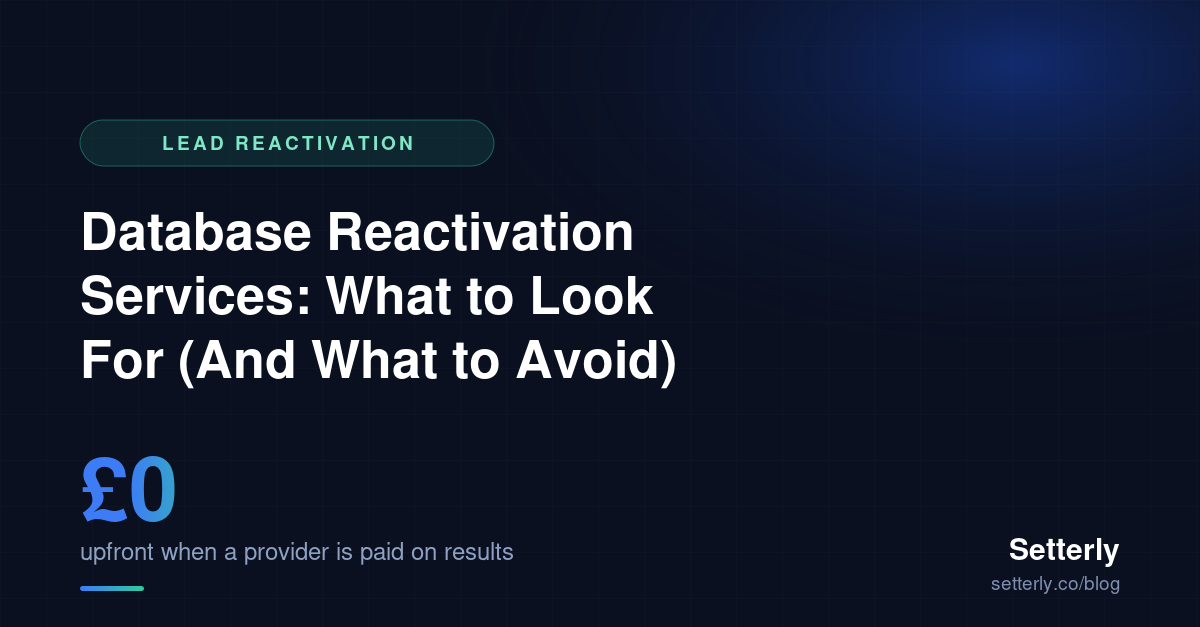
UK database reactivation services come in three types: DIY software you run yourself, agencies on a monthly retainer, and pay-per-appointment providers who run everything and charge only for booked appointments. The type decides who carries the risk, and it matters because 63% of enquirers take three months or more to buy, so your "dead" leads are worth fighting over.
The hard part is picking a provider. This market has brilliant operators and it has cowboys, and from the sales page they look identical. This guide gives you the categories, the evaluation checklist, the red flags, and the exact questions to ask any lead reactivation company, including us.
New to the concept itself? Read our database reactivation guide first, then come back.
The three types of database reactivation service
Almost every provider fits one of three categories, and the category tells you most of what you need to know about incentives.
| Provider type | Who does the work | How you pay | Risk |
|---|---|---|---|
| DIY software | Your team writes the campaigns and answers every reply | Monthly subscription plus message costs | Yours: you pay whether or not anything books |
| Retainer agency | The agency runs the campaigns | Fixed monthly fee | Mostly yours: the invoice arrives whatever the result |
| Pay-per-appointment service | The provider runs everything, including conversations and booking | Per booked, qualified appointment | Mostly the provider's: no appointments, no cost |
1. DIY reactivation software
You buy a platform, load your leads, and run campaigns yourself, typically for a monthly subscription plus per-message costs.
This works if you have someone in-house with the time and skill to write campaigns, handle replies within minutes, qualify prospects and book appointments. That last part is where DIY dies. The software sends messages fine. Replies then land in an inbox at 8pm on a Saturday, nobody answers until Monday, and the lead goes cold for a second time.
Buy software if you have a dedicated person to run it. Otherwise you are buying a gym membership for a gym you will never visit.
2. Agencies on retainer
An agency runs the campaigns for you, usually for a fixed monthly fee regardless of outcome.
You get expertise and hands-off delivery. The risk sits entirely with you, because the invoice arrives whether the campaign books 60 appointments or 6. Some retainer agencies are excellent. The structure just means you are paying for effort, and you wanted outcomes.
3. Pay-per-appointment reactivation services
The provider runs everything and charges per outcome, usually per booked appointment. Setterly sits in this category: clients pay per booked, qualified appointment, priced on their average job value, with no setup fee and no retainer, and nothing when nothing books.
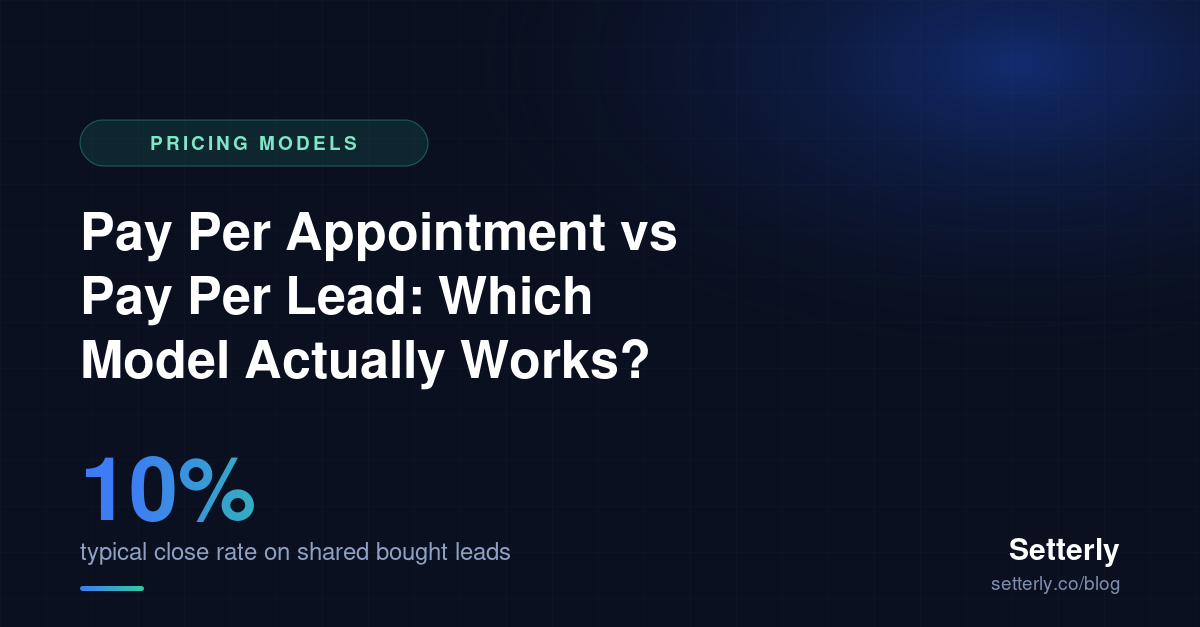
The incentive alignment is the point. A provider paid per appointment loses money on lazy campaigns, unqualified bookings and burned databases. We wrote up the full comparison in pay per appointment vs pay per lead.
Whichever category you lean towards, run the provider through the checklist below. Category alone guarantees nothing.
The evaluation checklist for lead reactivation services
Real conversations, or blast campaigns?
This is the single biggest quality divide in the market. Some services send one-way SMS blasts: a templated message, a link, done. Others hold genuine two-way conversations where the system reads each reply, responds naturally, handles objections and books the appointment inside the thread.
Blasts get flagged as spam, annoy the exact people you want back, and convert poorly. Conversations convert. Setterly has run 260,000+ SMS conversations, and our campaigns see reply rates of up to 66% because a real exchange feels nothing like a broadcast. See our how it works page for what a proper conversation flow looks like.
Ask to see a full example thread, from opening message to booked appointment. A provider doing this well will be proud to show you.
Does the pricing model align with your outcome?
Follow the money. If the provider gets paid before results exist, your results are a hope. If they get paid per booked appointment, your results are their revenue.
Connecting a CRM takes real work, so a one-off integration fee can be reasonable. At Setterly, CRM integration is optional at a one-off fee and there is no setup fee. The question is where the bulk of the money sits. Mostly upfront means the risk is yours. Mostly per-result means the risk is theirs. Our model is on the pricing page.
Proof with named clients
Anonymous screenshots and vague "we generated millions" claims cost nothing to fabricate. Ask for named clients, specific numbers, and quotes you could verify.
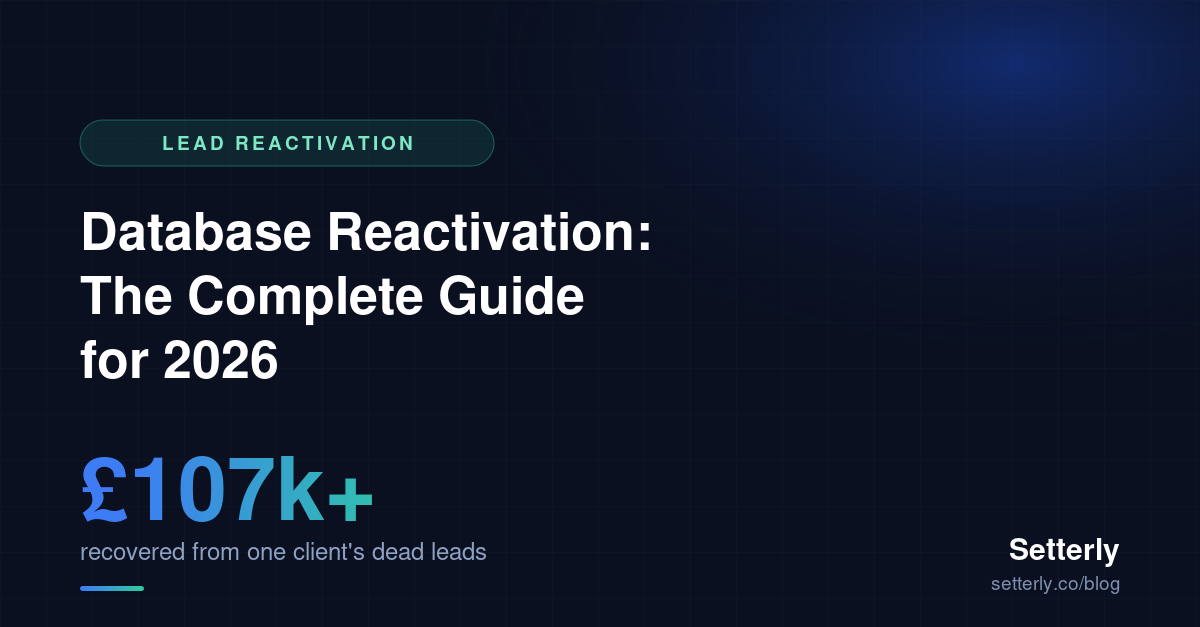
Hold every provider to the standard you would hold us to. Ours, for reference: Cloudy2Clear, a UK misted double glazing repair franchise, re-engaged 6,769 old enquiries with a 64% reply rate, booking 673 appointments and £639,350 in pipeline, with £107,000+ closed. CarFinance247, a UK car finance broker, booked 114 appointments over Christmas, and their Head of Paid Media, Emily Henshall, said: "Setterly helped us unlock additional value from a database of over 1,000,000 leads through AI-driven SMS outreach." Full details are in the Cloudy2Clear case study, the CarFinance247 case study and on our results page.
If a provider cannot name a single client, ask why.
Compliance and opt-out handling
Your database is made of real people protected by real law. In the UK that means UK GDPR and PECR. A competent provider will confirm the lawful basis for contacting your leads, honour opt-outs instantly and automatically, keep suppression lists, and put all of this in writing before a single message sends. Ours is on our trust page.
If a provider waves compliance away with "don't worry, everyone does it", end the call. The fines land on your business, and so does the reputational damage.
CRM integration and data handling
Two practical questions that separate professionals from amateurs. First, how does lead data get in and appointment data get out? Proper services integrate with your CRM so booked appointments, conversation history and opt-outs sync back automatically. A spreadsheet emailed weekly is a warning sign.
Second, what happens to your data afterwards? Your leads are a business asset. Get written answers on whether your data is ever used for other clients, whether it is sold or enriched, and what gets deleted when you leave. The correct answers are never, never, and everything you ask them to.
Red flags in database reactivation companies
Heavy upfront fees with no tie to results
Thousands upfront, a long contract, and no refund or credit mechanism if appointments never materialise. The provider has been paid in full before proving anything. Ask what happens contractually if month one produces zero appointments, and watch how straight the answer is.
Fake urgency blasts that burn your brand
"FINAL NOTICE: your discount expires TONIGHT" sent to 10,000 people who enquired eight months ago. These blasts can spike short-term replies while training your entire database to distrust your name. One cheap campaign can poison a list you spent years building. Ask to read the actual message copy before anything sends, and refuse anything you would be embarrassed to receive yourself. Our guide to SMS lead reactivation shows what good copy looks like.
No opt-out handling
If example messages carry no opt-out and the provider has no automatic suppression process, you are looking at a spam operation wearing a services badge. This one red flag reliably predicts all the others.
Guarantees of specific results before seeing your data
Nobody can promise "500 appointments" without knowing your list size, lead age, vertical and data quality. Honest providers give you a range after looking at your database. As a sanity check, our published campaigns have booked between roughly 3% and 13% of old leads, and Cloudy2Clear's was about 1 in 10. Treat anyone promising dramatically better than that, sight unseen, with suspicion.
Questions to ask any provider, including Setterly
Take this list into every sales call:
- What exactly do I pay, and when? What do I pay in a month with zero appointments?
- Can I see a full, real conversation thread from a past campaign, including the awkward ones?
- Which named clients can you point to, with numbers?
- What counts as a "qualified appointment", and who defines it?
- How do you handle opt-outs, suppression and UK GDPR/PECR compliance?
- How do you integrate with my CRM, and what syncs back?
- Who owns my data and the conversation history, and what do I take with me if I leave?
- What is the realistic appointment range for a database like mine, and what is it based on?
- How fast can we be live? Long timelines usually mean the provider is building something for the first time on your budget. Setterly campaigns go live within 14 days.
- What does my team have to change? The best answer is almost nothing: appointments land in the diary and your team turns up.
- How do you measure ROI? Demand one metric with money attached, such as booked appointments, not "engagement".
- What are the exit terms? Look for short notice, no exit fees and your data handed back in full. Lock-ins exist to protect providers from their own results.
Any provider worth hiring will answer all twelve without flinching, and we will happily go through ours line by line.
Frequently asked questions
What is a database reactivation service?
A service that re-engages the old, unworked leads in your CRM, usually via SMS conversations, qualifies the interested ones and books them into appointments. It monetises leads you have already paid for instead of buying new ones.
How much do database reactivation services cost?
DIY software charges a monthly subscription plus messaging costs. Agencies charge a fixed monthly retainer regardless of results. Pay-on-results services charge per booked appointment, so cost scales directly with outcomes. Setterly prices each appointment on your average job value, with no setup fee or retainer.
How do I know if a lead reactivation company is legitimate?
Look for named clients with verifiable numbers, real two-way conversation examples, written compliance and opt-out processes, CRM integration, clear data ownership and exit terms, and pricing weighted towards results. Refusal on any of these is your answer.
What results should I expect from database reactivation?
It depends on list size, lead age and vertical, so distrust anyone quoting exact figures before seeing your data. As a reference point, Setterly's Cloudy2Clear campaign re-engaged 6,769 old enquiries and booked 673 appointments, roughly 1 in 10, generating £639,350 in pipeline.