Pay Per Appointment vs Pay Per Lead: Which Model Actually Works?
 Cameron Richards, FounderUpdated 7 min read
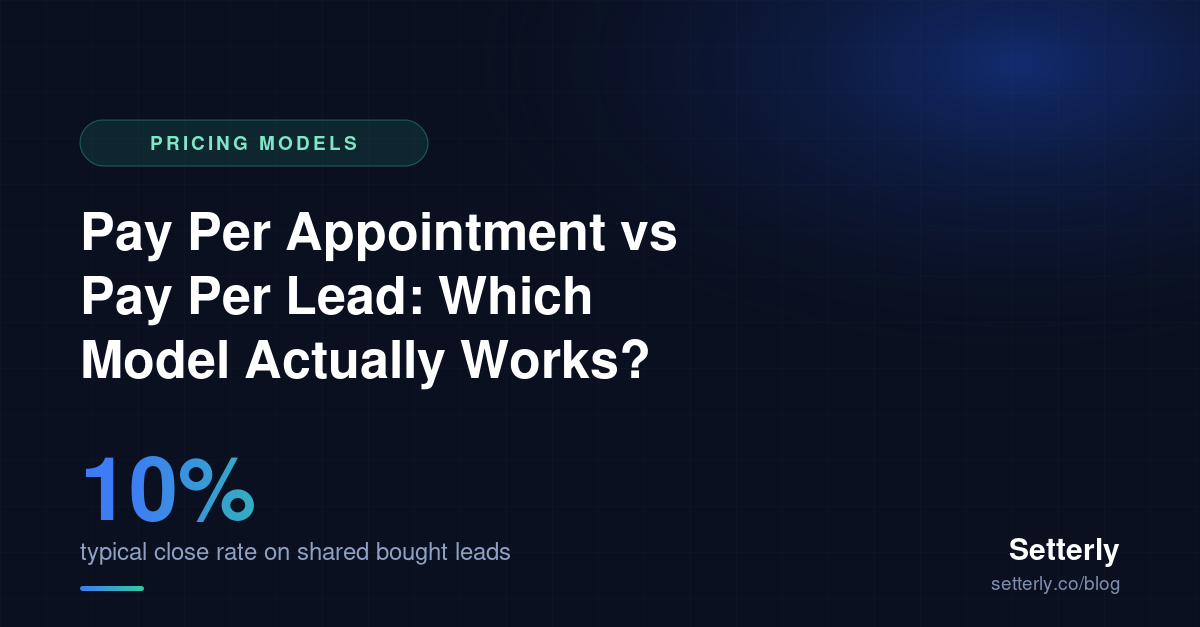
For most high-ticket home improvement and automotive businesses, pay per appointment works better than pay per lead, because you pay for a qualified prospect in your diary rather than a name and number. With shared leads, you pay full price for an enquiry other firms may also be calling, whether anyone answers or not.
That single fact explains why so many business owners feel like they are spending more on leads every year and closing the same number of jobs. The model you buy under matters as much as the marketing itself.
This post compares pay per lead and pay per appointment across the four dimensions that actually decide your return: incentive alignment, quality control, risk, and cost predictability. Then we will be honest about where each model belongs.
The two models, defined
Pay per lead: you pay a fixed fee for each enquiry, typically a name, number, and a rough description of the job. Payment is due on delivery of the contact details. What happens next is your problem.
Pay per appointment: you pay only when a qualified prospect is booked into your calendar. The provider handles the contact, the conversation, and the qualification. Payment is due when the appointment exists.
Both are legitimate models used by serious appointment setting services and lead generation companies. They just put the risk in very different places.
Incentive alignment: who gets paid for what?
This is the dimension that drives everything else, so start here.
A lead seller's revenue event is the delivery of contact details. Once the lead lands in your inbox, their economics are complete. Whether the number connects, whether the person remembers enquiring, whether the job ever happens: none of it touches the seller's bank account. A rational lead seller maximises volume, because volume is what they sell.
An appointment provider's revenue event is a booked conversation. Nothing gets invoiced until a qualified prospect commits to a time in your calendar. A rational appointment provider maximises the number of enquiries that turn into real conversations, because conversations are what they sell.
Neither party is villainous. Both respond to their own incentives, exactly as you do. The question to ask any provider is simple: what event triggers my invoice? Everything upstream of that event will be optimised. Everything downstream of it is your problem.
The takeaway: pay per lead optimises for contact details. Pay per appointment optimises for conversations.
Quality control: where does the filtering happen?
Under pay per lead, you are the quality filter. Every lead arrives unqualified, and your team burns hours separating live enquiries from tyre-kickers, wrong numbers, and people who filled in six forms in one evening. With shared leads the problem compounds, because the prospect may be fielding several sales calls for one job.
Under pay per appointment, the provider is the quality filter, and the incentive points the right way. An appointment provider who books rubbish appointments has an unhappy client, a cancellation problem, and a dead account. Qualification is where their margin lives, so timeframe, intent, and fit get checked before anything reaches your calendar.
Setterly's own qualification happens inside real SMS conversations. Across 260,000+ conversations, our AI asks the questions a good setter would ask: is the problem still live, what is the timeframe, when suits you to talk? Only leads that pass become appointments. That is how a campaign for Cloudy2Clear, a UK misted double glazing repair franchise, produced 673 booked appointments from 6,769 old enquiries and £639,350 in pipeline. The full process is on our how it works page.
The takeaway: under pay per lead you buy raw material. Under pay per appointment you buy a finished unit of sales opportunity.
Risk: who carries the downside?
Every marketing model puts risk somewhere. The only question is on whose side of the table it sits.
With pay per lead, you carry it all. You pay before you know whether the lead answers, before you know whether they are qualified, and before you know whether competitors got the same file. A bad month of lead quality is entirely your loss, and contractors already lose 30-50% of their leads to follow-up gaps before quality even enters the equation.
With pay per appointment, the provider carries the performance risk. If the campaign underdelivers, the provider absorbs the cost of the work, and your invoice shrinks with it. A month with no appointments is a bad month for the provider and a free month for you.
The takeaway: pay per lead prices the attempt. Pay per appointment prices the outcome.
Cost predictability: what does a customer actually cost?
Pay per lead looks predictable on the surface, because the unit price is fixed. But the number you actually manage a business on is cost per sold job, and under pay per lead that figure swings with every variable you don't control: lead quality, sharing, your team's speed to phone, and answer rates. A £50 lead is cheap at a 20% close rate and ruinous at 2%.
Pay per appointment moves the fixed price much closer to revenue. You know what a booked, qualified conversation costs before the month starts, and your cost per sale becomes a function of one variable you fully control: how well you sell in the appointment. Budgeting gets simpler, and so does the maths when you decide whether to scale.
Here's a real example. A single-branch UK window and door installer booked 22 appointments with us in its first 30 days, at a 41% reply rate. It closed £31,483 of work and paid £1,520 in appointment fees. The window and door case study has the detail.
The takeaway: fixed cost per lead hides a volatile cost per sale. Fixed cost per appointment exposes it.
Where pay per lead genuinely makes sense
A fair comparison admits this: pay per lead suits some businesses well.
If you sell a high-volume, low-ticket service, run a trained inbound team that responds within minutes, and can profitably close even a modest percentage of raw enquiries, buying leads at scale can work. Boiler servicing, basic repairs, and simple insurance products often fit this shape. The model rewards operations that treat lead handling as a production line.
The model punishes everyone else. If your jobs are high-ticket, your sales capacity is limited, or your follow-up depends on whoever is free between site visits, you will pay full price for a pipeline you cannot properly work. For those businesses, and that is most home improvement and automotive operations we speak to, paying for outcomes beats paying for raw volume every time. If you're weighing up the UK lead platforms specifically, read whether Checkatrade, Bark and Rated People leads are worth it.
The version most comparisons miss: appointments from leads you already own
Here is the twist in how Setterly runs the pay per appointment model. Most appointment setting services generate new cold prospects and charge you for booking them. We work the asset you have already paid for once: the old, unworked leads sitting in your CRM.
The maths favours it heavily. 63% of people who request information don't buy for 3 months or more, which means the majority of your historic enquiries went quiet before they were ready rather than because they said no. Those people already know your business. The acquisition cost was paid months ago. The method is in our database reactivation guide.
Our AI re-engages them with real SMS conversations, referencing their original enquiry, answering their questions, qualifying timeframe and intent, and booking them straight into your calendar. Setterly has booked 3,000+ appointments this way for 30+ businesses. CarFinance247, a UK car finance broker, booked 114 appointments and £171,000 in pipeline over Christmas. The numbers are on our results page.
You pay per booked, qualified appointment, priced on your average job value. No setup fee, no retainer for activity, no invoice for effort. CRM integration is optional, at a one-off fee. If nothing gets booked, nothing gets paid. Our pricing page explains the model.
Frequently asked questions
What is the difference between pay per lead and pay per appointment?
Pay per lead charges a fixed fee for each enquiry's contact details, paid regardless of quality or outcome. Pay per appointment charges only when a qualified prospect is booked into your calendar, so the provider carries the risk of contacting, qualifying, and scheduling.
Is pay per appointment better than pay per lead?
For most high-ticket service businesses, yes, because you pay for outcomes rather than raw contact details and the provider is incentivised to qualify properly. Pay per lead can still suit high-volume, low-ticket operations with fast, dedicated inbound sales teams.
How much do pay per lead services cost?
It varies widely by platform, trade and area, and shared leads are often sold to more than one firm. Your true cost per sale depends on how many of those leads you actually reach and close, which is why cost per sale is the number to track.
How does Setterly's pay per appointment model work?
Setterly re-engages the old leads already in your CRM using real AI SMS conversations, qualifies intent and timeframe, and books appointments into your calendar. You pay per booked appointment, priced on your average job value, with no setup fee or retainer. If no appointments are booked, you pay nothing.