How to Win Back Cold Leads After the 7-Day Drop-Off
 Cameron Richards, FounderUpdated 6 min read
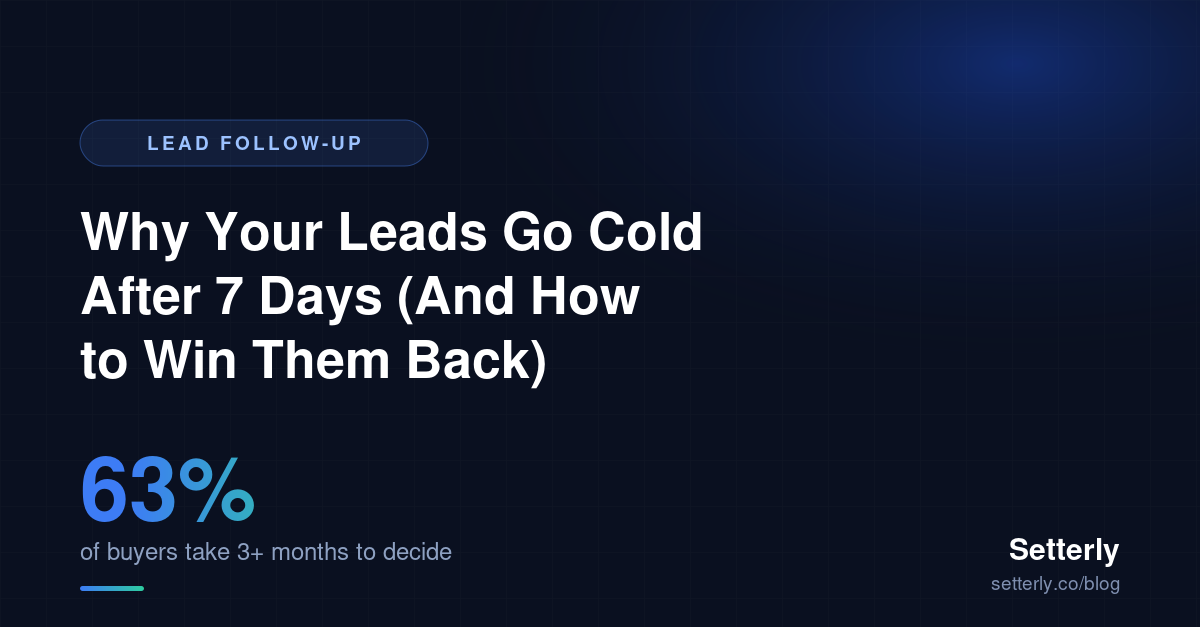
To win back cold leads, segment them by why they stalled, reopen with a short text that references their original enquiry, then answer every reply within minutes. Most leads go cold because follow-up stops after five to seven days, while 63% of people who request information don't buy for three months or more.
Sit with those two numbers for a second. The buyer's decision window opens weeks after your team has already moved on. That gap is where a huge chunk of your revenue quietly dies.
This post breaks down why leads go cold, why the 7-day mark is where most pipelines fall apart, and how to follow up with old leads in a way that actually books appointments.
The 7-day cliff: why follow-up stops
Watch any busy sales team and you'll see the same pattern. A new lead comes in, gets a call, maybe two or three more over the next few days, then a final "just checking in" message. After that, silence.
It happens for predictable reasons. New leads keep arriving, and fresh always feels more promising than stale. Commission structures reward whoever closes fastest, so reps chase the enquiries most likely to close this week.
The CRM makes it official. Five call attempts with no answer, mark it "no response", move on. The lead is now filed as dead.
For contractors and home improvement firms this is brutal. Research shows contractors lose 30-50% of their leads to poor follow-up, and most owners have no idea it's happening because the leads were logged, called a few times, and marked closed.
Your buyers are on a completely different timeline
Here's what your CRM never tells you. The person who ignored five calls in week one is often still very much in the market.
They requested a quote, then life got in the way. A holiday, a school run crisis, a busy month at work. Or they're comparing three quotes and waiting for a partner to agree. Or the money lands next quarter, so they went quiet until it does.
Silence in week one usually means "not yet". Your process reads it as "never".
So you get two curves moving in opposite directions. Sales effort peaks in the first seven days and then collapses. Buyer intent builds slowly and often peaks two, three, even six months later. The overlap between the two is tiny, and everything outside it leaks out of your pipeline.
The maths of leads going cold
Say you generate 300 leads a month and convert 15% inside the first week. That leaves 255 people who told you they wanted something, sitting untouched in your CRM.
If 63% of buyers take three months or longer to decide, a big slice of those 255 will eventually buy. The only question is whether they buy from you or from the competitor who happened to call the week they were ready.
And you've already paid for every one of them. Ad spend, landing pages, forms, phone lines. The acquisition cost is sunk. Letting them rot is choosing to write that money off.
There's a second advantage hiding here too. Selling to someone who already knows your business succeeds 60-70% of the time, against 5-20% for a brand new prospect. Old leads already know you. They enquired. Half the trust-building is done.
How to follow up with old leads (without annoying them)
Winning cold leads back takes a system, and the system has four parts. The long-form version is our database reactivation guide.
1. Segment before you send
Split your database by age and by why each lead stalled. Someone who never answered the phone needs a different message from someone who received a quote and went quiet. A 60-day-old lead needs a different opener from an 18-month-old one.
2. Open with context, ask a real question
The message that works acknowledges the gap and gives them an easy way back in. Something like: "Hi Sarah, you asked us about a new bathroom back in March. Still on the cards, or has it moved down the list?"
One question. Easy to answer either way. No pressure, no "just circling back".
3. Hold an actual conversation
Most reactivation attempts fail here. A single blast SMS with a booking link gets ignored because it's obviously a broadcast. Replies come with questions, objections, and half-answers, and each one needs a response within minutes, at any hour.
This is why speed matters so much. Leads contacted within 5 minutes are roughly 9x more likely to convert than those contacted after 30 minutes, and the same logic applies to replies. A lead who texts back at 9pm on a Sunday is hot right now, and cold again by Tuesday. The numbers are in our speed to lead statistics.
This is the part AI does better than any human team. At Setterly our AI holds real two-way SMS conversations, answers questions instantly, qualifies the lead, and books the appointment straight into the diary. You can see exactly how it runs on our how it works page.
4. Qualify, book, hand over
The end goal is a booked appointment with a qualified prospect, handed to your sales team with full context of the conversation. Your closers should only ever speak to people who have confirmed they're still interested and picked a time.
What this looks like in the real world
Cloudy2Clear, a UK misted double glazing repair franchise, had thousands of enquiries marked dead across their branches. Classic 7-day cliff: called a few times, no answer, filed away.
We re-engaged 6,769 of those old enquiries by SMS. 4,321 replied, a 64% reply rate. The campaign booked 673 appointments and generated £639,350 in pipeline, with £107,000+ closed. The full story is in our Cloudy2Clear case study.
Every one of those 673 people had already been written off. They hadn't stopped wanting their windows fixed. They'd just stopped hearing from anyone. If you run a glazing business, our windows and doors page shows how this works for your trade.
Across all our clients we've now booked 3,000+ appointments and handled 260,000+ SMS conversations doing exactly this. The full numbers are on our results page.
Stop the leak at both ends
The long-term fix is twofold. Extend your follow-up window from 7 days to 90+ with automated, conversational touchpoints, using a cadence like the one in how many times to follow up with a lead. And run a reactivation campaign on everything already sitting cold in your CRM, because that backlog is the fastest revenue you'll find anywhere this quarter.
Your competitors are chasing the same expensive new clicks you are. The buyers who already raised their hand are sitting in your database, waiting for a message.
Frequently asked questions
How long does it take for a lead to go cold?
Most sales teams stop following up after 5 to 7 days, which is when a lead is typically marked cold. Buyer research shows 63% of people who request information take 3 or more months to purchase, so many "cold" leads are still actively in the market.
How do you follow up with old leads?
Segment leads by age and reason they stalled, then send a short personalised SMS that references their original enquiry and asks one easy question. Respond to replies within minutes, qualify their interest, and book an appointment while attention is high.
Is it worth contacting leads that are over a year old?
Yes, if the message is personalised and the purchase is one people delay, like home improvements or car finance. Setterly's campaign for Cloudy2Clear re-engaged 6,769 old enquiries and booked 673 appointments, generating £639,350 in pipeline.
Why do sales teams give up on leads so quickly?
New enquiries feel more promising, commission rewards fast closes, and CRMs encourage marking unresponsive leads as dead after a handful of attempts. The result is that follow-up effort peaks in week one while buyer intent often peaks months later.